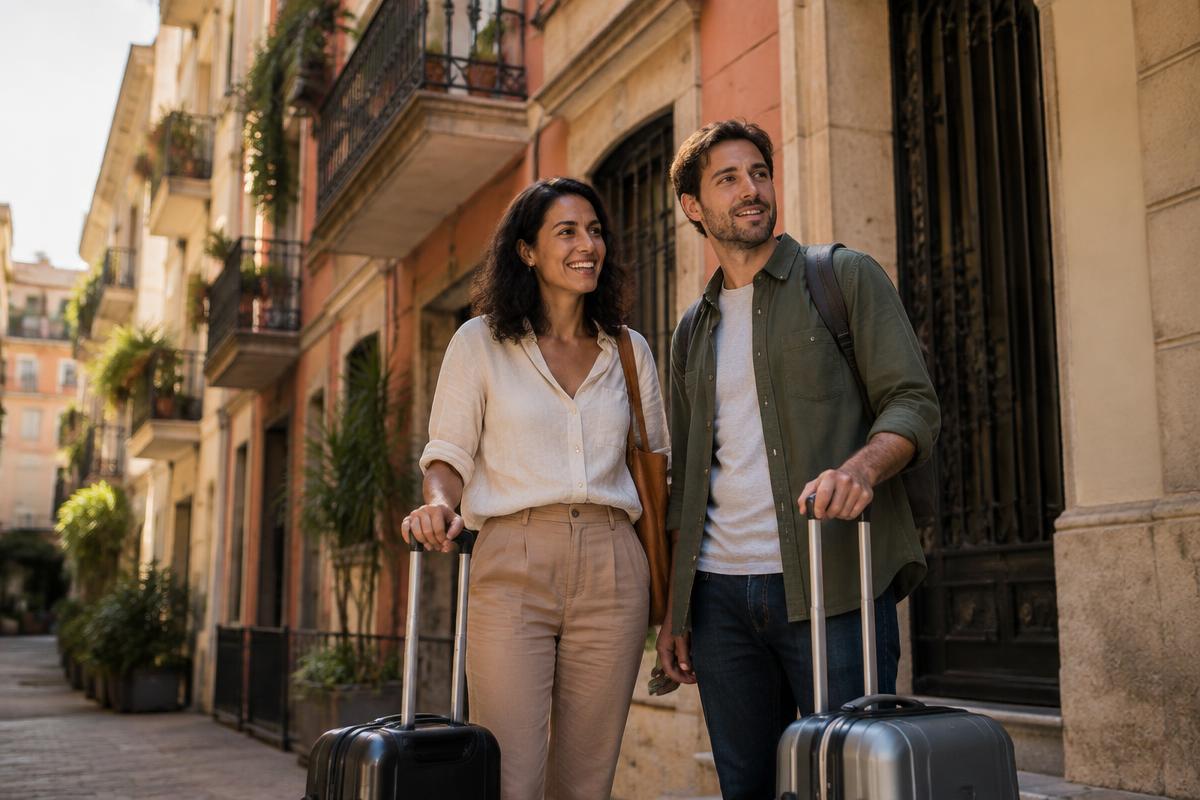
We're a multicultural couple who left the US for Spain — and the questions started rolling in the second we posted about it. This guide pulls together everything we wish we'd known before booking the flight: visa choices, where to land first, what the paperwork actually feels like, and how to build a community when you don't share one passport.
If you're a binational, mixed, or long-distance couple considering moving to Spain from the US, this is the practical, lived-in version — not the glossy expat brochure.
Most Americans moving to Spain in 2026 land on one of three visa tracks: the Digital Nomad Visa (DNV), the Non-Lucrative Visa (NLV), or a work/sponsored visa. For remote workers and freelancers with US clients, the Digital Nomad Visa is usually the fastest, friendliest path — it allows remote work for non-Spanish employers, includes your spouse and kids, and opens a path to long-term residency.
The Non-Lucrative Visa is the classic 'I have savings and won't work in Spain' option — great for early retirees and sabbaticals, but you can't legally work remotely on it. A sponsored work visa is rare unless a Spanish employer is actively recruiting you.
Apply through the Spanish consulate that covers your US state. Start the document collection (apostilled FBI background check, notarized birth and marriage certificates, private health insurance with no copays, proof of income) two to three months before you book a consulate appointment — appointments at Miami, NYC, and LA often book out 6–10 weeks.
Income threshold: roughly €2,760/month for the main applicant in 2026, plus ~€1,035 for a spouse and ~€345 per additional dependent. Self-employed applicants need clients outside Spain making up at least 80% of income.
You'll need a clean criminal record from anywhere you've lived in the last two years (apostilled), a university degree OR three years of professional experience in your field, private Spanish health insurance with full coverage, and proof of an existing client or employer relationship at least three months old. UGE (three-year permit on approval). The in-country route is faster and increasingly common for couples — but only if you're comfortable doing paperwork in Spanish or hiring a gestor.
Barcelona is the easiest landing pad for a multicultural couple. It's bilingual by default (Spanish + Catalan, with English widely spoken in the tech and creative scene), the international community is huge without being insular, and you can build a life without a car. For couples where one partner is still adjusting to Spanish, the language pressure is much gentler than in Madrid or Seville.
But Barcelona is expensive and the rental market is brutal. Expect €1,400–€2,200/month for a decent one-bedroom in Eixample, Gràcia, or Poblenou, and be ready to show a Spanish bank account, NIE, and three months of payslips before a landlord will even reply. If your budget is tighter or you want slower days, look at Valencia, Málaga, or Bilbao — all DNV-friendly with strong international communities. Spotahome, Flatio, or a local agency) for your first 2–3 months before signing a long lease. You'll know within a month whether the neighborhood actually fits you.
Week 1–2: book your empadronamiento (town hall registration) appointment and your TIE (residency card) fingerprinting appointment. Both fill up fast in Barcelona and Madrid — set alarms for when the city's appointment system refreshes, usually early morning. N26 and Revolut work for day one, but you'll need a brick-and-mortar account (BBVA, CaixaBank, Banco Sabadell) for your rental contract and utilities. Bring your passport, NIE, and proof of address.
Week 4–8: register with the Seguridad Social if your visa requires it, set up a gestor (€60–€120/month) to handle taxes, and sign up for the public health system or maintain your private policy. Get your TIE card, then update your bank, lease, and phone contract with the TIE number.
Skip the temptation to do everything yourself in month one. A good gestor pays for themselves the first time you avoid a Agencia Tributaria fine.
If you're in Spain more than 183 days in a calendar year, you become a Spanish tax resident — meaning Spain taxes your worldwide income. The US still taxes you too (citizenship-based), but the US-Spain tax treaty and the Foreign Earned Income Exclusion (FEIE, ~$130,000 in 2026) prevent most double taxation.
Digital Nomad Visa holders can apply for the Beckham Law regime — a flat 24% Spanish tax on Spanish-source income (up to €600,000) for up to six years, with foreign income generally exempt. You must apply within six months of registering with Social Security, so don't sleep on it. FBAR, Form 8938) and Spanish (Modelo 100, Modelo 720 for foreign assets >€50,000) filings. Expect $1,500–$3,500/year for both. It's worth every euro.
The hardest part of moving to Spain as a mixed couple isn't the paperwork — it's rebuilding the community that took you years to grow at home. Plan for it on purpose. Mundo Lingo and local café meetups are everywhere), signing up for one recurring class together (cooking, padel, ceramics — anything that puts the same faces in front of you weekly), and saying yes to every invitation for the first 90 days even when we were tired.
Find your people across more than one circle: the international/expat circle is easy and gives you instant friends, but make sure you also build at least one local Spanish-speaking circle. Long term, that's what makes Spain feel like home instead of a long vacation.
If you're an interracial or LGBTQ+ couple, Barcelona, Madrid, and Valencia are genuinely welcoming, and there are active multicultural family meetups in each. Smaller pueblos can be lovely but slower to warm up — visit before you commit.
Realistic monthly budget for a couple in Barcelona (2026): rent €1,600–€2,000, groceries €400–€600, eating out €300–€500, transit €40 each (T-usual pass), private health insurance €100–€180 for two, gestor + phones + utilities ~€300. A comfortable life lands around €3,500–€4,500/month — significantly cheaper than NYC, LA, or the Bay Area. Revolut, not your US bank's wire transfer. Keep a US credit card open for the credit score and for booking US flights. Open a Spanish brokerage only after you understand Modelo 720 reporting — for most newcomers, keeping investments in US accounts (with a US address-of-record solution) is simpler.
Apostille every document twice. You'll need copies for the consulate, the empadronamiento, the bank, the gestor, and at least one 'I lost it' backup. Spain runs on stamped paper. IKEA, Wallapop, and second-hand stores in Spain.
Learn enough Spanish to handle a phone call before you arrive. Doctor's offices, the Padrón, and your landlord will not switch to English. Even broken Spanish opens doors that perfect English never will.
Give yourself a full year before judging the move. The first three months are admin, the next three are loneliness, and somewhere around month seven you wake up and realize you live here.
UGE portal for in-country DNV applications, and the Seguridad Social and Agencia Tributaria sites once you're here.
Community: r/GoingToSpain and r/expats on Reddit, the Spain Expat Telegram groups, and local Facebook groups for your city (search '[city] expats' and '[city] international').
Want to ask us anything we didn't cover? Send us a note or collaborate with us — we read every message and update this guide as the rules and our experience evolve.