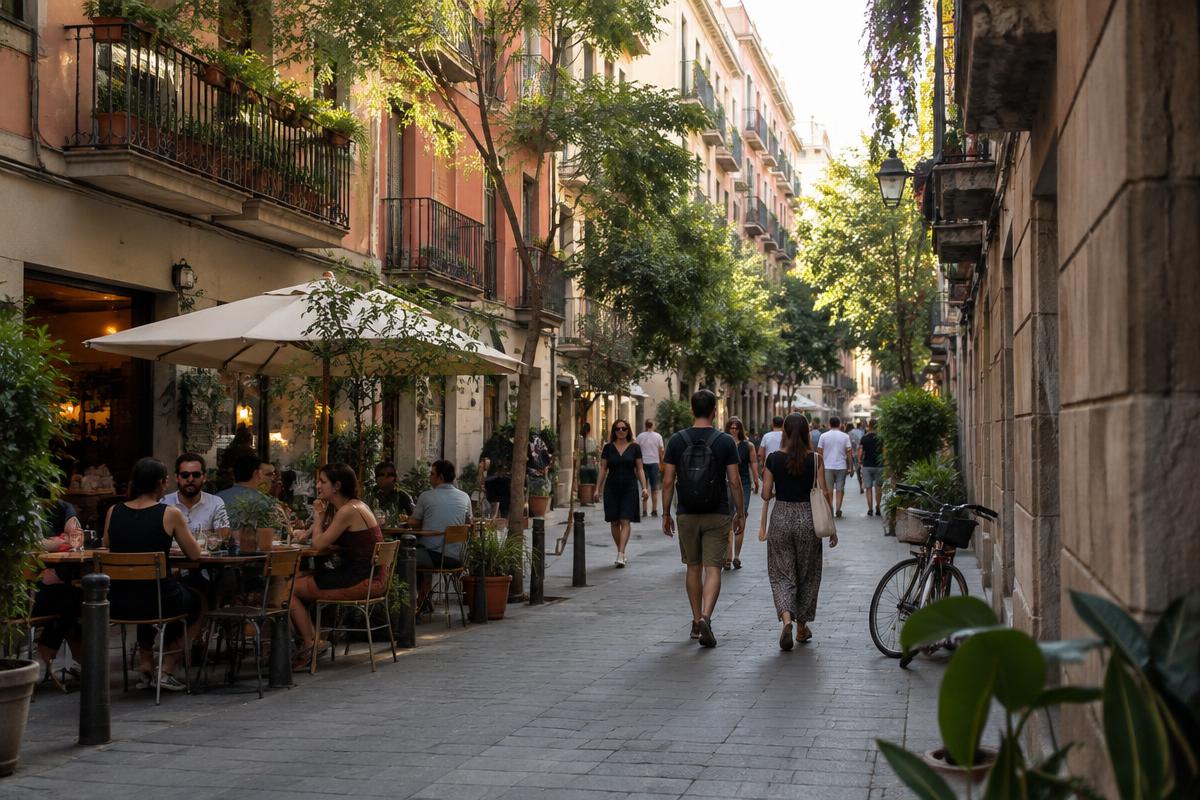
Barcelona has roughly 73 official barrios across 10 districts, but as a US expat you'll seriously consider maybe 10 of them. This guide ranks the neighborhoods that actually work for foreign couples and remote workers — based on rental availability, English-friendliness, walkability, safety after dark, transit, and the kind of community that makes a city feel like home.
We've lived in Eixample and Gràcia; everything below combines our experience, friends' experience, and 2026 rental-market data from Idealista, Fotocasa, and the city's housing observatory. Use the dynamic Latest Updates section above for the freshest rent and regulation changes.
The big grid neighborhoods between Plaça Catalunya and Sagrada Família. Eixample Dreta is the eastern half (more residential, family-friendly, walking distance to Gràcia); Esquerra de l'Eixample is the western half (more bars and gay scene around 'Gaixample').
Why we'd pick it: most listings, easiest to land a flat from abroad, walkable to almost everything, every metro line, the highest concentration of English-speaking services (gyms, coworking, doctors).
Trade-offs: traffic noise on the major axes (Aragó, Diputació, Gran Via). Look for interior or chamfered-corner flats. Rents have risen ~10% in 2 years.
Rent range (1BR, 2026): €1,500–€2,300/month. 2BR: €2,000–€3,200.
Best for: couples on DNV who want a soft landing, people who haven't visited Barcelona before, anyone who doesn't want to learn the transit map.
Gràcia is the neighborhood every long-term resident eventually moves to. Narrow streets, small plazas (Plaça del Sol, Plaça de la Virreina, Plaça Rovira), an outsized number of independent cafés and bookshops, and a strong neighborhood identity (the Festa Major de Gràcia in August is one of Europe's best street festivals).
Why we'd pick it: real community, walkable, less touristy than Eixample or the Gothic Quarter, easy access to Park Güell, the best café and restaurant density per square meter in the city.
Trade-offs: limited metro coverage (Fontana, Joanic, Lesseps are it — buses fill the gaps). Old building stock means elevators are rare and AC is often missing. Apartments turn over slowly.
Rent range (1BR, 2026): €1,300–€1,900/month. 2BR: €1,800–€2,700.
Best for: couples planning a multi-year stay, people who want walkable village life, freelancers and creatives.
Old industrial district turned tech and creative hub (Barcelona's '22@' innovation zone). Wide streets, modern buildings mixed with renovated warehouses, the most coworking spaces in the city, and a 10-minute walk to Bogatell or Mar Bella beach.
Why we'd pick it: the closest thing Barcelona has to a Brooklyn neighborhood — walkable, beachy, a real remote-work scene, less touristy than the city center, family-friendly with several international schools nearby.
Trade-offs: less classic Barcelona charm if that's what you came for. Some streets still feel industrial. Heavy construction in the eastern part of 22@.
Rent range (1BR, 2026): €1,200–€1,800/month. 2BR: €1,700–€2,500.
Best for: DNV holders working US hours, couples who actually use the beach, families with kids in international schools.
The neighborhood just west of the Raval, anchored by the renovated Mercat de Sant Antoni. Quietly become one of the most desirable areas for young couples in 2024–2026 — less touristy than the Gothic Quarter, livelier than Eixample, and significantly more affordable than Gràcia or Poblenou.
Why we'd pick it: great food scene without the markup, walkable to everything central, metro on L2 (Sant Antoni) and walking distance to Plaça Universitat, slightly cheaper than Eixample for similar quality.
Trade-offs: limited green space, narrower streets, can feel dense in summer.
Rent range (1BR, 2026): €1,200–€1,800/month. 2BR: €1,700–€2,400.
Best for: couples who want central living without Eixample prices, food-obsessed expats.
Upper Barcelona, just north of the Diagonal. Quieter, leafier, more residential. Sant Gervasi has more density and shops; Sarrià feels like a small Catalan village inside the city.
Why we'd pick it: best for families with kids (excellent international schools nearby — Benjamin Franklin, American School of Barcelona), low crime, lots of green space, the FGC train line for fast access to the center.
Trade-offs: less nightlife, less of the international scene, you'll lean on a metro/FGC commute, and 'cheap' starts at €1,800.
Rent range (1BR, 2026): €1,400–€2,200/month. 2BR: €2,200–€3,500.
Best for: families, couples who want a quieter daily rhythm, anyone who finds central Barcelona overwhelming.
The medieval streets just east of the Gothic Quarter. Iconic, beautiful, lined with tapas bars, gallery spaces, and Picasso Museum tourist traffic.
Why we'd pick it: the most photogenic neighborhood in Barcelona, walkable to everything, vibrant nightlife and food scene.
Trade-offs: very loud at night (late-night tapas crowds, occasional 4am noise), heavily tourist-trafficked, smaller flats with limited natural light, fewer long-term locals than Gràcia or Sant Antoni.
Rent range (1BR, 2026): €1,300–€2,000/month. 2BR: €1,900–€2,800.
Best for: couples doing a 6–18 month Spain experiment, night owls, anyone who values 'a postcard apartment' over peace and quiet.
Technically part of the same district as El Born but a few blocks north, away from the heaviest tourist density. Mercat de Santa Caterina is the local hub.
Similar charm to El Born with meaningfully less noise. Increasingly popular with expats who want the medieval feel without sleeping above a tapas bar.
Rent range (1BR, 2026): €1,200–€1,800/month. 2BR: €1,700–€2,500.
El Raval: rich diversity and great food, but the south end has real safety issues for residents (petty crime, drug-related activity around Sant Pau del Camp). North Raval near MACBA is fine but loud.
Barceloneta: the beachfront neighborhood is iconic but loud, touristy, and most landlords here run short-term tourist flats — long-term residential rentals are scarce and expensive.
La Barceloneta and the Gothic Quarter are great to visit but rough as a daily-living base unless you really, really like crowds.
Outskirts (Horta, Nou Barris): much cheaper (€700–€1,200 for a 1BR) but transit is a real commute and the international community is thin. Only worth it if your Spanish is solid.
Barcelona announced in 2024 that ALL short-term tourist apartment licenses (HUTs) will be phased out by November 2028 — over 10,000 units will return to the long-term market. Early effects are visible: in late-2025 and 2026, mid-term furnished supply rose meaningfully in Eixample and Poblenou.
City Hall capped year-over-year rent increases on existing leases at the Spanish housing law's reference index in 'stressed' zones — most of Barcelona qualifies. New leases are not capped, which is why headline rents on Idealista still rose ~7% in 2025.
The minimum income requirement most landlords ask for is now 3.0–3.5x the monthly rent (up from 2.5–3.0x in 2023). DNV approval letters increasingly serve as proof of income alongside US payslips and bank statements.
The dynamic Latest Updates section above tracks Ayuntamiento decisions, HUT-to-long-term conversions, and rent index updates as they're published.
Phase 1 (before flying): book a furnished mid-term place via Spotahome, Flatio, or a local agency for 2–3 months. Expect to pay 15–30% above long-term rates. This gives you a Spanish address for empadronamiento and bank-account opening.
Phase 2 (weeks 4–8 in Spain): start the long-term search on Idealista and Fotocasa. Set Telegram or app alerts for new listings — the best ones go in 12–48 hours. Be ready with: DNI/TIE, NIE, last 3 months' bank statements, employer/client letters, and a Spanish bank account.
Use a tenant agent if your time is tight (Renting Smart, Habitatio, BCN Advisors) — €300–€800 fee but they have agency relationships and can shortcut the listing-to-signing process.
Phase 3: long-term lease is typically 5 years (LAU) with renewal protections. Deposit is one month's rent (fianza) held by INCASOL; landlord usually asks for one additional month as 'guarantee' (legal up to two months extra). contact us.